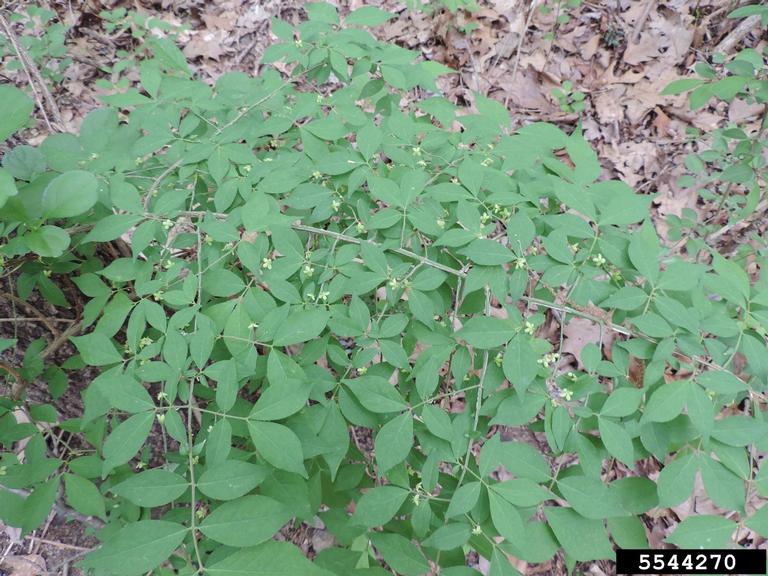
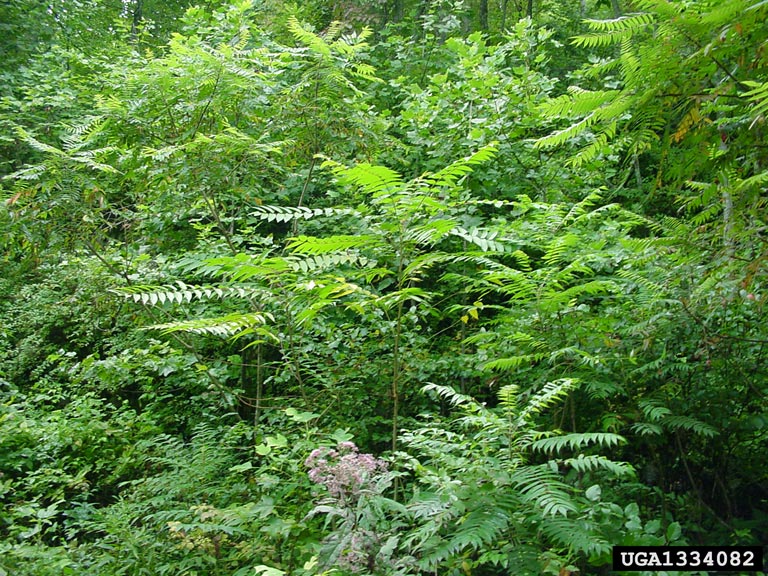
Common buckthorn, Paul Wray, Iowa State University, Bugwood.org

Common buckthorn, Paul Wray, Iowa State University, Bugwood.org
The MIPN Invasive Plant Control Database provides control techniques, which compiles and ranks the effectiveness of control methods for many invasive plants common to the Midwest.
Information in the database reflects scientific literature review, consultation with experts in the field, and user input. In fact, if you have experience controlling any of the species listed below, you can help improve the database by submitting a case study. Each case study includes details about the control method used, the specific location treated, and the effectiveness of the treatment. We are happy to receive case studies for methods included in the database that either support or counter the effectiveness ranking in the database, and we are happy to receive case studies for methods not currently included in the database as well.
The project is the result of a partnership between MIPN and the Weed Science Program at the University of Wisconsin-Madison’s Cooperative Extension.
Plants included in the database are:
Amur honeysuckle
Asian bittersweet
Autumn olive
Bird’s-foot trefoil
Black locust
Black swallow-wort
Border privet
Bull thistle
Canada thistle
Common buckthorn
Common privet
Common tansy
Common teasel
Creeping bellflower
Crown-vetch
Cut-leaved teasel
Dame’s rocket
European marsh thistle
Field bindweed
Garlic mustard
Glossy buckthorn
Hill mustard
Hybrid cattail
Japanese barberry
Japanese hedge-parsley
Japanese honeysuckle
Japanese hop
Japanese knotweed
Japanese stiltgrass
Leafy spurge
Morrow’s honeysuckle & x. Bell’s
Multiflora rose
Musk thistle
Narrow-leaved cattail
Plumeless thistle
Poison hemlock
Purple loosestrife
Quackgrass
Russian olive
Sericea lespedeza
Spotted knapweed
Spreading hedge-parsley
Tartarian honeysuckle & x. Bell’s
Tree-of-heaven
White sweetclover
Wild chervil
Wild parsnip
Yellow sweetclover
Search Example Screenshot:


Woody Invasives of the Great Lakes Collaborative (MIPN Resource) – Published in 2020, this site provide a comprehensive overview of the management practices known to be effective on woody plant species. The PDF generator feature on every page allows users to build their own handbooks.
Woody Invasive Plant Management Demos – The Renz Weed Science Lab (2023) is conducting demonstrations of woody invasive plant management at several sites in Wisconsin. You can take a virtual tour of their demonstration sites where they are managing common buckthorn, bush honeysuckle, and Japanese barberry. You can also access information on the effectiveness and cost of each demonstrated herbicide method.
Integrated Vegetation Management Handbook – H-1740-2, United States Bureau of Land Management, 2008. (pdf – 5 MB). Integrated vegetation management is the practice of integrating multiple invasive plant management and revegetation strategies to meet plant community management goals. Although this guide focuses on the specific program elements used by BLM, many of the approaches are broadly applicable.
Weed Control Management Handbook: Tools and Techniques for Use in Natural Areas, The Nature Conservancy, 2003 (pdf – 1.5 MB). This guidebook includes overviews and important considerations for a number of invasive plant control and natural area management methods, including physical removal, grazing, prescribed fire programs, biological control and herbicide use.
Identifying and Managing Aquatic Vegetation – APM-3-W, Purdue Extension, 2009 (pdf – 2.5 MB). This guide discusses ecological problems caused by an over-abundance of aquatic vegetation and provides information on aquatic invasive plant identification and control methods.
Targeted Grazing: A natural approach to vegetation management and landscape enhancement, University of Idaho, 2006 (pdf – 11.5 MB). Targeted gazing, also known as prescribed grazing, is the strategic employment of livestock to meet land management objectives. This guidebook describes the basic framework and considerations for the use of grazing as a tool to control unwanted vegetation.
Wildland Fire in Ecosystems: Fire and Non-Native Invasive Plants, U.S. Forest Service, 2008 (pdf – 14.5 MB). This guide explores the use of prescribed fire as a management tool for nonnative invasive plants. It synthesizes scientific information, addresses plants of concern by bioregion, and discusses emerging issues.
Best Practices Handbook for Roadside Vegetation Management, Minnesota Department of Transportation, 2008 (pdf – 5 MB). This handbook describes best strategies and practices for managing roadside vegetation, including management planning, public relations, weed/invasives control, and use of native plant species.
Invasipedia – This wiki-style resource houses information on invasive plants, animals, and pathogens and their management. Its foundation is the large amount of species management information developed by the The Nature Conservancy’s Global Invasive Species Team.
Invasive Species: Manager’s Toolkit – National Invasive Species Information Center, U.S. Department of Agriculture.
“Herbicide Treatments for Controlling Invasive Bush Honeysuckle in a Mature Hardwood Forest in West-Central Indiana,” Rathfon, R. and K. Ruble, 2007, Proceedings of the 15th Central Hardwood Forest Conference. (pdf – 454 kB)
Callery pear presentation, including control methods. Belcher, J., 2007, (pdf – 5 MB)
Callery pear flyer, developed by the Missouri Department of Conservation (pdf – 404 kB)
Canada thistle lifecycle graphic, developed by the Minnesota Department of Agriculture and University of Minnesota Extension (pdf – 2 MB)
Common buckthorn lifecycle graphic, developed by the Minnesota Department of Agriculture and University of Minnesota Extension (pdf – 2 MB)
Great Lakes Phragmites Collaborative, website featuring management techniques, best practices guides, case studies, and more. Funded through the Great Lakes Restoration Initiative.
“Phragmites Field Guide: Distinguishing Native and Exotic Forms of Common Reed in the United States,” USDA – Natural Resources Conservation Service, Boise, Idaho, 2012. (pdf – 1 MB)
“Effect of Glypro Herbicide On The Aquatic Macroinvertebrate Community In A Recently Burned Phragmites Marsh”, This study in Ohio looked at the impact of Glypro, applied to control Phragmites, on the wetland macroinvertebrate community. (MS Word – 70 kB)
“Invasive Phragmites – Best Management Practices 2011” Ontario Ministry of Natural Resources, Peterborough, Ontario. (pdf – 4 MB)
Common tansy lifecycle graphic, developed by the Minnesota Department of Agriculture and University of Minnesota Extension (pdf – 2 MB)
Myriophyllum spicatum L. data, including control techniques, from the U.S. Geological Survey, Great Lakes Aquatic Nonindigenous Species Information System, 2018
State of Michigan’s Status and Strategy for Eurasian Watermilfoil Management, Michigan Department of Environmental Quality, 2018. (pdf – 1 MB)
Glossy buckthorn lifecycle graphic, developed by the Minnesota Department of Agriculture and University of Minnesota Extension (pdf – 2 MB)
Great Lakes Hydrilla Collaborative website featuring comprehensive information about early detection, management, and monitoring techniques; case studies; research findings; and more. Funded through the Great Lakes Restoration Initiative.
Proceedings of the 2010 Stiltgrass Summit, River to River CWMA.
Management of Microstegium vimineum by Dr. S. Luke Flory. (MS Word – 712 kB)
MIPN’s Homeowners’ guide to Japanese knotweed management (pdf)
ID and Treatment Brochure, Minnesota Department of Agriculture, 2018. (pdf – 7 MB)
Knotweeds lifecycle graphic, developed by the Minnesota Department of Agriculture and University of Minnesota Extension (pdf – 2 MB)
Kudzu Identification & Eradication Project, Indiana Dept. of Natural Resources, Division of Entomology and Plant Pathology.
Kudzu Control, Missouri Dept. of Conservation.
Leafy spurge lifecycle graphic, developed by the Minnesota Department of Agriculture and University of Minnesota Extension (pdf – 2 MB)
Lesser celandine control methods, Wisconsin DNR.
“Workplan for Lesser Celandine (Ranunculus ficaria) Control in Rocky River Reservation,” Cleveland Metroparks Technical Report 2008. (pdf – 1 MB) First year update 2009 (pdf – 1 MB)
Multiflora rose lifecycle graphic, developed by the Minnesota Department of Agriculture and University of Minnesota Extension (pdf – 2 MB)
Narrowleaf bittercress lifecycle graphic, developed by the Minnesota Department of Agriculture and University of Minnesota Extension (pdf – 2 MB)
Conservation Practice Job Sheet – Brush Management, Oriental Bittersweet, National Resource Conservation Service (New Hampshire) (pdf – 131 kB)
Oriental Bittersweet Best Control Practices, Michigan Natural Features Inventory, 2012 (pdf – 321 kB)
Palmer amaranth identification and treatment, information by Hartzler, B., College of Agriculture Life Sciences and Iowa State University Extension and Outreach, 2016.
“Palmer Amaranth Biology, Identification, and Management” Purdue Extension, Legleiter, T. and Johnson, Bill, 2013. (pdf – 1 MB) Copies of the article can be purchased here by searching for WS-51.
Plumeless thistle lifecycle graphic, developed by the Minnesota Department of Agriculture and University of Minnesota Extension (pdf – 2 MB)
Purple loosestrife lifecycle graph, developed by the Minnesota Department of Agriculture and University of Minnesota Extension (pdf – 3 MB)
Reed canary grass control information, Minnesota Dept. of Agriculture, includes
“Reed Canary Grass Management Guide: Recommendations for Landowners and Restoration Professionals” Wisconsin Reed Canary Management Working Group, 2009. (pdf – 2 MB)
Spotted knapweed prevention and management, Minnesota Dept. of Agriculture.
“Spotted Knapweed Best Management Practices in Ontario,” Ontario Invasive Plant Council (pdf – 3 MB)
Spotted knapweed lifecycle graphic, developed by the Minnesota Department of Agriculture and University of Minnesota Extension (pdf – 2 MB)
Wild parsnip lifecycle graphic, developed by the Minnesota Department of Agriculture and University of Minnesota Extension (pdf – 2 MB)
The Midwest Invasive Plant Network manages a collaborative partnership on woody invasive species in the Great Lakes Basin aptly named the Woody Invasives of the Great Lakes (WIGL) Collaborative.
Launched in 2020, the WIGL website provides a “one-stop-shop” to learn about woody invasive species identification, biology, distribution, regulation, native alternatives, and management options.
Be sure to check out the WIGL blog! Here you will find articles from researchers and invasive species professionals on topics ranging from biocontrol, new invasives impacting the Great Lakes region, and both innovative, and tried and true, management techniques.
The WIGL Collaborative is focusing its efforts on 28 species that are
All of these species were introduced historically for landscape use, either in gardens or for erosion control or wildlife forage. Some of them are still commonly planted, while others are no longer popular. Most of these species are spread through similar mechanisms and are controlled using the techniques. We are developing a new website as a clearinghouse of information on the WIGL species and on preventing the spread and controlling woody species in general. Stay tuned!
(listed by type and alphabetically by Latin name)
Trees
Woody Vines
Shrubs