Environmental Change

Chinese privet, Karan A. Rawlins, University of Georgia, Bugwood.org

The Future of Midwest Invasive Plants

One of the many anticipated, and to some extent already observable, impacts of environmental change is that plants in the Northern Hemisphere, including invasive plants, are likely to shift their ranges northward. Milder winters and higher minimum winter temperatures along with changes in precipitation patterns will play an important role in future habitat suitability. 

By the year 2100, under a moderate emissions scenario, a place such as Michigan’s Lower Peninsula could start feeling like the Ozarks, or even Western Oklahoma. To help visualize how these environmental changes will impact species distribution, the Northeast RISCC team worked with EDDMapS to develop tools that help predict the potential mid-century (2040-2060) ranges of 896 terrestrial invasive plant species.

Read this full article to learn more about these tools and how they can be used. MIPN also recorded a webinar that includes a demonstration of these tools.
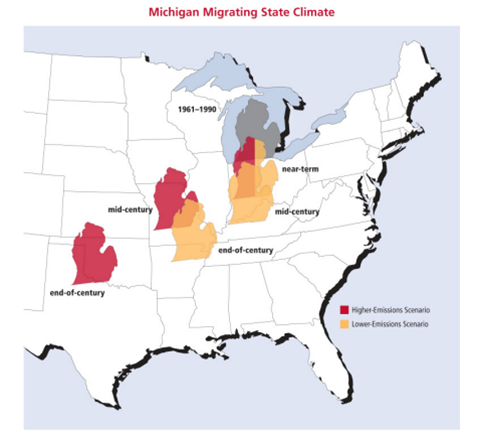
Michigan Migrating State Climate Map
Michigan Migrating State Map: Depending on greenhouse gas emissions, Michigan's Lower Penninsula could start feeling like the Ozarks, or even Western Oklahoma, by 2100. https://www.ucs.org/sites/default/files/2019-09/midwest-climate-impacts.pdf

Potential Midwestern Range-Expanding Species

MIPN staff used tools in EDDMapS to make a list of species with reasonable potential for range expansion in the Midwest based on environmental suitability. These species are grouped by (2012) USDA Plant Hardiness Zone, below. Users should consider these species relative to their projected future hardiness zone (see Figure 2) rather than their current zone. Zone 7 hardy species are likely to be new introductions to the Midwest as a whole, while species hardy to zone 6 or lower may already be showing invasiveness in the southern part of the region. While invasive plants tend to be quite adaptable, some may only grow aggressively in preferred soils or habitat types. Even when there is high model agreement about a species’ future range, it is not guaranteed that the species will definitely spread and become invasive in any given location.
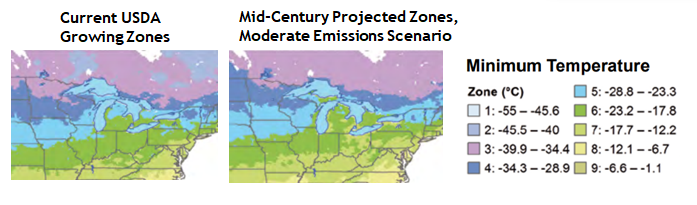
Projected Zone Shifts Map

Zone 7 Hardy Species

Zone 6 Hardy Species

Zone 5 Hardy Species

  • Invasive Plant Atlas Profile
  • Future range not modeled for aquatic species
  • Invades still and moving freshwater systems up to 20′ deep
  • Stems form dense mats near the water surface
  • Invasions compromise navigation, irrigation, recreation and displace native species
  • Northern populations spread by seed and vegetatively
  • Invasive Plant Atlas Profile
  • Future Range Map
  • Future Certainty Map
  • Juvenile form is dense, creeping groundcover, adult is climbing vine
  • Popular ornamental groundcover/low shrub with many cultivated varieties
  • Invades forest openings and edges, choking and covering other plants
  • Spread can be vegetative (juvenile) and through bird dispersal of seed (adult)
  • Invasive Plant Atlas Profile
  • Future Range Map
  • Future Certainty Map
  • Ornamental flowering woody climbing vine
  • Can grow as a climber or a sprawling groundcover outside of cultivation
  • Invades forest openings, edge habitats, and rights-of-way, choking and covering other plants
  • Large volumes of fluffy-tailed seed dispersed by wind
  • Invasive Plant Atlas Profile
  • Future Range Map
  • Future Certainty Map
  • Semi-woody perenial (sub-shrub) historically planted for forage and erosion control
  • Invades open habitats such as praries, grasslands, pastures, and rights-of-ways
  • Large volumes of seed dispersed by wild animals, livestock and human activity
    • Forms a long-lived seedbank
  • Invasive Plant Atlas Profile
  • Future Range Map
  • Future Certainty Map
  • Ornamental flowering trees
  • Self-sterile cultivars are cross-pollinated by insects, resulting in viable seed
  • Establishes in distrubed areas, open habitats and forest edges, but can spread to interior areas over time
  • Spread through ornamental trade and by fruit-eating birds