
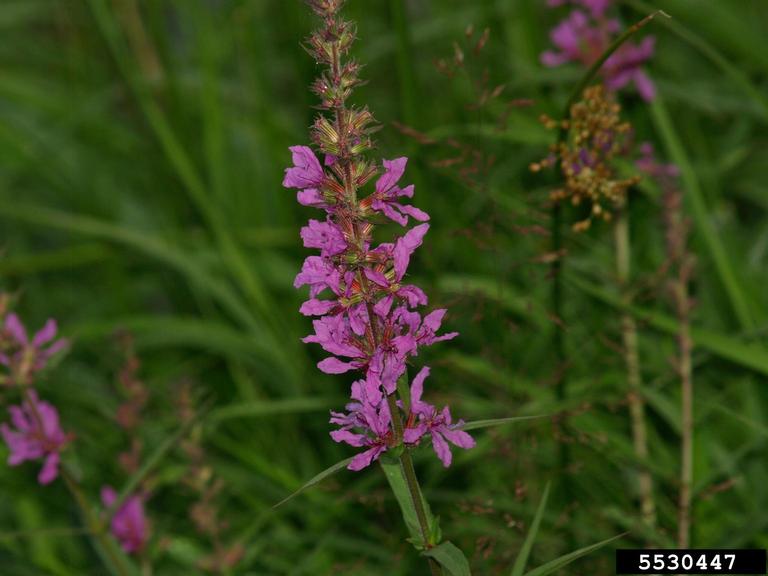
Purple Loosestrife, Becca MacDonald, Sault College, Bugwood.org
Purple Loosestrife, Becca MacDonald, Sault College, Bugwood.org
Over 450 plant species are considered to be invasive, noxious, or pests by one or more jurisdictions in the Midwestern U.S. The following regional list compiles all the plant species regulated through state law and/or listed as invasive by a state agency or invasive plant council in the 10 states and provinces that MIPN serves. If a plant is regulated by law, you will see a notation under the state abbreviation in blue text on the left side of the table. If the plant is listed as invasive, the notation will be below the state abbreviation in red text on the right side of the table.
Links to the appropriate state laws or agency/plant council webpages are provided in the index below. If you are aware of an updated list or amended law, please help us keep this list up to date by emailing MIPN’s Director at mipn@mortonarb.org.
The table below lists plants alphabetically by Latin name but is easily searchable by common or Latin name – just start typing in the search box! You can also sort the database by clicking the carrot next to each column header.
Last updated October 2025
Aq = Aquatic Injurious Plant Species
N = Noxious Weed
E = Exotic Weed
1 = Severe Threat
2 = Significant Threat
3 = Lesser Threat
R = Restricted Plant
Pt = Prohibited Terrestrial Plant
PAq = Prohibited Aquatic Plant
H = High Invasive Rank
M = Medium Invasive Rank
L = Low Invasive Rank
C = Caution Species
Pr = Primary Noxious Weed
A = General Invasive Plant List
Pn = Prohibited Noxious Weed Seed
Rn = Restricted Noxious Weed Seed
1 = Severe Invasive Threat
2 = Significant Invasive Threat
3 = Lesser Invasive Threat
PAq = Prohibited Aquatic Plant
RAq = Restricted Aquatic Plant
E = Noxious Weed, Eradicate List
C = Noxious Weed, Control List
R = Noxious Weed, restricted list
SR = Specially Regulated Plant
A = Established Population (2019)
B = Present but Not Established (2019)
C = Not Present, Potentially Invasive (2019)
U = Population Status Unknown
Missouri Law
A = Population > 1,000 in 1 or more of MO’s natural divisions (2018)
B = Population 100 – 1,000 in 1 or more of MO’s natural divisions (2018)
C = Population 10 – 100 in 1 or more of MO’s natural divisions (2018)
D = Population <10 in 1 or more of MO’s natural divisions (2018)
I = Insufficient data
1 Illinois list developed in 2004, modified in 2011 via IL DNR contractor (informal assessment)
2 Indiana list is based on assessments by the Indiana Invasive Species Council’s Plant Advisory Committee
3 Iowa list developed by Iowa DNR and USDA Forest Service
4 Kentucky list developed by Kentucky Invasive Plant Council in 2015
5 Michigan list developed by the Michigan Invasive Species Program (EGLE, DNR, & MDARD)
6 Minnesota list derived from presence/absence data published by the Minnesota Invasive Species Advisory Council in 2019 – full MISAC analysis considers several other factors
7 Missouri list derived from distribution and population data published by the Missouri Invasive Plant Council in 2019 – an assessment update in is progress
8 Ohio list from the Ohio Invasive Plants Council’s plant assessments
9Invasive Exotic Plant Species Ranking for Southern Ontario, Society of Ecological Restoration, 2025
10 Invasive Plants Association of Wisconsin’s Working List of Invasive Plants, originally published in 2003
11 Species is native to North America (though not necessarily the Midwest – see www.bonap.net for nativity info)
12Regulatory status varies by county – see regulations for details
13Certain cultivated varieties or hybrids excluded – see regulations for details
14Certain uses or growing conditions excluded – see regulations for details
15In a phase out period, restricted noxious weed status goes into effect January 1, 2029
16Restrictions go into effect January 1, 2027
17Restrictions go into effect January 1, 2028
18Restrictions go into effect January 1, 2029
19Only applies to specific cultivars- see regulations for details