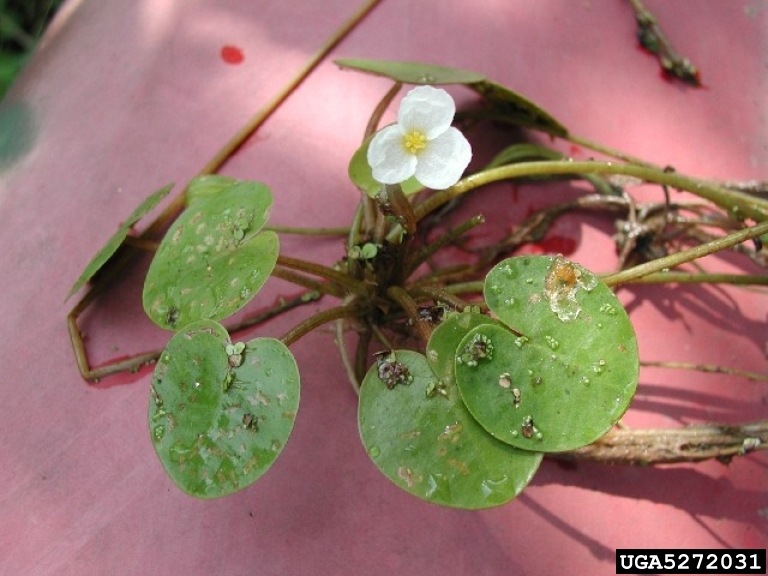
Common teasel, Emily Finch, duboisswcd.org
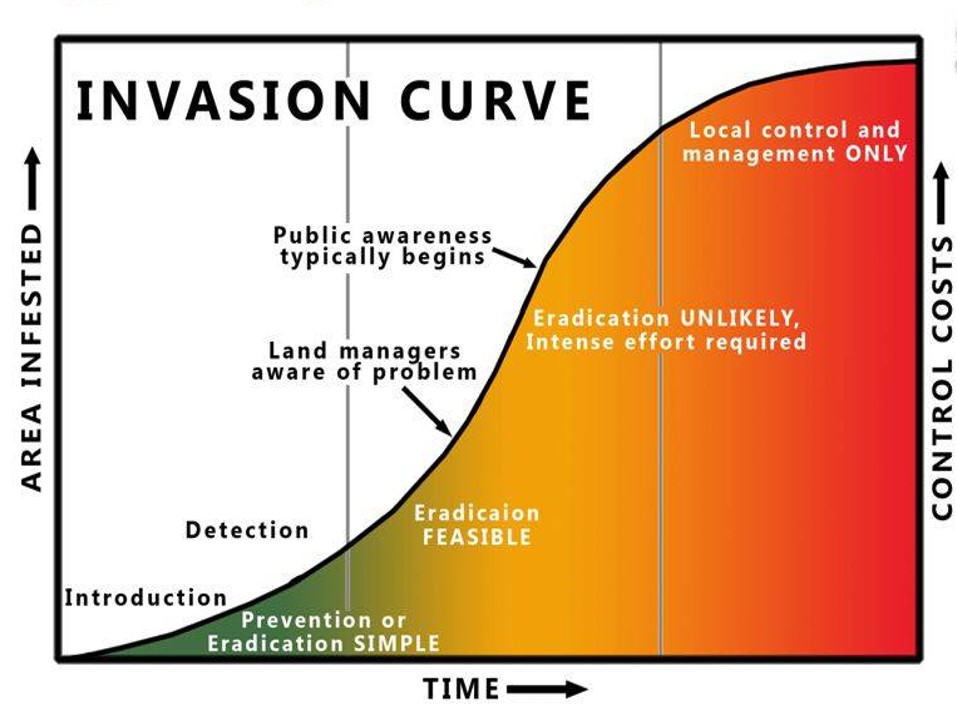
Early detection and rapid response (EDRR) are practices that enable land managers to identify new and spreading invasive species quickly, and to enact control quickly, before the species population grows to the point where it cannot be locally eradicated.
The graph below shows the typical pattern of invasive species population growth over time. Unfortunately, historically society has not done a great job of realizing when species are becoming invasive, and most people are not aware of a problem until the invasive population is so large that it is impossible to eradicate. The best managers can hope for at that point is to control the population sizes to reduce impacts. Examples of ubiquitous invasive species whose populations are at the right (red) side of the curve include Asian bush honeysuckles (Lonicera sp.) and Canada thistle (Cirsium arvense). The goal of EDRR practices is to notice invasive species problems earlier, towards the left (green) side of the curve, and to take control actions when populations are still relatively small and eradication is feasible.
If land managers are made aware of new instances of invasive species soon after they arrive, the managers can take action to control—and hopefully eradicate!—these populations before they become large in size. We especially encourage people who spend a lot of time outdoors to become familiar with early detection species and to report sightings using these tools.
You can report your sightings to EDDMapS! EDDMapS stands for Early Detection and Distribution Mapping System. It is a web-based citizen science tool that allows people to report and map the invasive plants they are seeing in their area, and to have those reports verified by local experts. You can report species either through the EDDMapS website or the EDDMapS app (available for iOS and Android – just search your app store for EDDMapS). The EDDMapS homepage can also connect you to training materials, distribution maps, and more.
You can also report sighting to the Midwest Invasive Species Information Network (MISIN) is a regional data aggregation effort to develop and provide an early detection and response (EDR) resource for invasive species in the Midwest region of the United States. This effort is led by researchers with the Michigan State University Department of Entomology Laboratory for Applied Spatial Ecology and Technical Services in conjunction with a growing consortium of supporting partners. The goal of this regional resource is to assist both experts and citizen scientists in the detection and identification of invasive species. Report an invasive species to MISIN.

The Nonindigenous Aquatic Species (NAS) information resource for the United States Geographical Survey (USGS) is a central repository for spacially referenced biogeographic reports of introduced (non-native) aquatic species. The program provides scientific reports, online/real time queries, spatial data sets, distribution maps, and general information. The data are made available for use by biologists, interagency groups, and the general public. Report an aquatic invasive species sighting here.
Public gardens and arboreta have a unique role to play in preventing the introduction and spread of invasive species. As living collections of plants from around the world, these institutions are often the first to acquire new exotic plants and bring them to the United States. With expert staff and dedicated volunteers, public gardens are also in a unique position to be able to observe and record instances of new plants spreading and showing invasive potential. As a continuation of our “Invasive Plants in Trade” work with the horticulture industry, MIPN works with The Morton Arboretum and the Ohio Invasive Plants Council to help gardens better organize and share information about potentially invasive plants. Find more details about this project here.

Are you a gardener? Are you interested in environmentally friendly management of shared spaces such as school grounds, public parks, or through a homeowners’ association? Are you a professional landscaper? The plants we choose for our managed landscapes and gardens have a profound impact on the introduction and spread of invasive plants. Learn more about what you can do to prevent the spread of garden and landscape invasives here. You might also be interested in MIPN’s guide to “Landscaping with Native Plants to Ward Off Invasives and Benefit Wildlife“.

Do you enjoy outdoor recreation? Whether you’re a hiker, dog walker, camper, birder, hunter, fisher, ATV rider, or boater, there are steps you can take to avoid moving invasive plants from place to place, described here.
A regional early detection species is one that is either not yet present in the Midwest, but is prevalent and spreading in neighboring regions, or present in the Midwest in relatively small or isolated populations with high risk of further spread.
MIPN has been conducting emerging invasive species surveys since 2020. Feedback is requested from invasive plant experts in every state and province in our region. In 2025, we had 76 responses, with each state and province represented.
Keep in mind that since MIPN covers such a large area, not all species named in the survey are considered emerging species in every state or subregion of the Midwest. That being said, it is wise to avoid planting any of the species cited below and we recommend learning to identify and report sightings of these plants in natural areas. Information submitted to invasive monitoring databases, such as EDDMapS, the Midwest Invasive Species Information Network (MISIN), or the Nonindigenous Aquatic Species information resource (NAS), is used to prioritize and strategically manage invasive species to control further spread and can help inform policy decisions.
We have categorized feedback from our 2025 survey into 4 areas: terrestrial plants most frequently named, aquatic plants most frequently named, invasive plants that are a high priority for monitoring in specific regions of the Midwest, and plants of growing concern due either to an increase in the number of times a plant was cited relative to previous years and/or an increase in the number of locations where this plant is now a concern. For more details read our 2-page summary and review a year-by-year comparison of all plants that have been named in these surveys.
Stiltgrass (Microstegium viminieum)
Chaff flower (Achyranthes japonica)
Lesser celandine (Ficaria verna)
Swallow-worts (Cynanchum spp.)
Porcelain berry (Ampelopsis brevipedunculata)
Teasels (Dipsacus spp.)
Poison hemlock (Conium maculatum)
Amur corktree (Phellodendron amurense)
Kudzu (Pueraria montana var. lobate)
Japanese hop (Humulus japonicus)
Transylvanian cephalaria (Cephalaria transsylvanica) – Detected growing wild in Missouri for the first time in 2024. Prioritize monitoring and reporting this species in Missouri and Arkansas.
Butterbur (Petasites hybridus) – Reporting in the upper Midwest and Great Lakes region has been gradually increasing. Prioritize monitoring and reporting this species particularly in Michigan, Minnesota, Wisconsin, and Ontario.
Red hailstone aka Goldencreeper (Thladiantha dubia) – Red hailstone is also a priority species for the Upper Midwest. Prioritize monitoring and reporting this species particularly in Wisconsin and Minnesota.
European frog-bit (Hydrocharis morsus-ranae)
Hydrilla (Hydrilla verticillata)
Flowering rush (Butomus umbellatus)
Starry stonewort (Nitellopsis obtusa)
Water lettuce (Pistia stratiotes)
Water primrose (Ludwigia grandiflora ssp. hexapelata)
Parrot feather (Myriophyllus aquaticum)
These plants have all continued to increase in how often they are cited as a priority for early detection relative to previous surveys:
Wintercreeper (Euonymus fortunei)
Chinese silvergrass (Miscanthus sinensis)
Wineberry (Rubus phoenicolasius)
Chinese yam aka Cinnamon vine (Dioscorea polystachya)
These plants were cited by survey takers in more states than in 2024. See summary for additional details.
Small carpetgrass (Arthraxon hispidus) – 6 states (3 in 2024)
Chinese yam aka Cinnamon vine (Dioscorea polystachya) – 7 states (2 in 2024)
Golden rain tree (Koereuteria paniculata) – 5 states (only 1 in 2024)
Defining early detection species on a regional level can be tricky. It is also valuable for people to know what species are new and spreading in their neck of the woods. State agencies and invasive plant councils are a great resource, as are any local CWMAs. Here are some state-wide resources that we have identified:
Listed below are the top two plants that were named the greatest concern for each state/province. In the case of an even number of responses, more than two species are listed: