The Public Gardens as Sentinels against Invasive Plants (PGSIP) initiative brings together public garden representatives to collaboratively identify and address plants escaping from cultivation. PGSIP is guided by a working group led by The Morton Arboretum along with MIPN, Missouri Botanical Garden, Royal Botanical Gardens, Chicago Botanic Garden and other key partners.
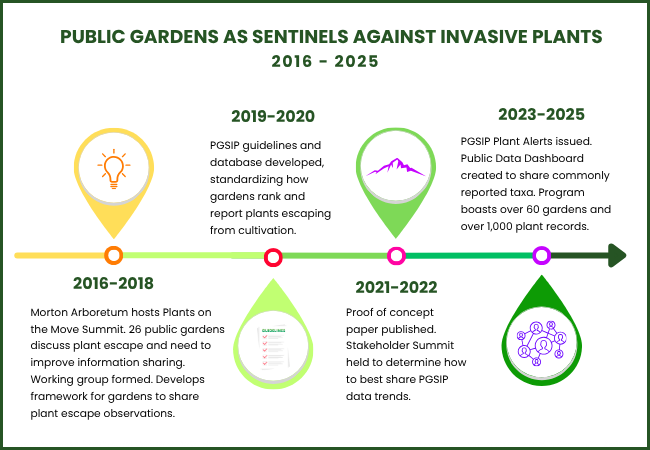
In November of 2016, MIPN worked with The Morton Arboretum and the Ohio Invasive Plants Council to host an event called the Plants on the Move Summit. Representatives from 26 U.S. and Canadian public gardens attended to discuss how various institutions are currently addressing plants escaping and how the public garden community can better share and communicate observations of plants escaping cultivation with each other, with their visitors, and with the general public. A report summarizing the summit proceedings, discussions, and findings of this meeting is available (pdf). One of the primary findings of the summit was that the public garden community would benefit from garden staff being able to share observations between institutions of plants escaping cultivation.
A PGSIP working group was formed in 2018 to develop a framework whereby gardens could share these types of observations. Institutions that participated in the launch of the PGSIP working group included: Holden Arboretum, Lady Bird Johnson Wildflower Center, Missouri Botanical Garden, Morton Arboretum, New York Botanical Garden, and Royal Botanical Gardens. They were later joined by the Chicago Botanic Garden.
An article about the project was published in 2019 in Public Garden, the Journal of the American Public Gardens Association (view pdf file here). In 2020, the PGSIP working group released a set of guidelines intended to help public garden staff easily list and rank plants escaping from cultivation in a standardized way based on their observations. Rankings including Watchlist, Potentially Invasive, Invasive and Assessed as Invasive. Development of the Guidelines was followed by creation of an online database that allows public gardens to upload and share their ranked lists. A 2022 “proof of concept” paper was published in Biodiversity and Conservation using plant lists from 7 public gardens that were generated prior to developing the new PGSIP guidelines. This study demonstrates how gardens have been paying attention to invasive species within their properties, but it also emphasized the need for gardens to work together and share their information. In 2025, the working group published a new paper in Invasive Plant Science and Management, a journal of the Weed Science Society of America, summarizing nearly 1,000 plant records collected from more than 50 gardens across the U.S. and Canada. Reports include both observations of non-native, collection plant escape as well as plants assessed by gardens as invasive. Some of the most reported species such as Amur corktree (Phellodendron amurense), burning bush (Euonymus alatus), and wintercreeper (Euonymus fortunei) are frequently recognized as invasive. However, 36% of the species reported were not listed as invasive by any U.S. state or Canadian province, suggesting that gardens may be detecting these plants at the earliest stage of invasion.
Through a Data Dashboard and Plant Alerts, PGSIP provides advance notice on plants of concern to help reduce their introduction and spread.